

At 11 o'clock on Thursday 15 January around 350 people broke into a choreographed dance routine in London's Liverpool Street Station for the shooting of a new advertising campaign by T-Mobile.
Take a look...
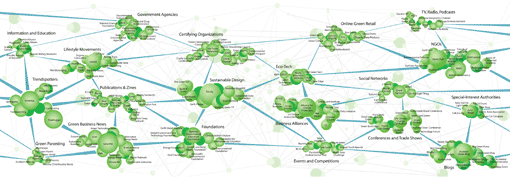
Brand expert Richard Seireeni interviewed over two dozen "ecopreneurs" from a broad range of industries - home improvement, transportation, household products, food and beverage, energy, real estate, finance, and fashion. The collective experience of leaders such as Gary Hirshberg of Stonyfield Farm, Jeffrey Hollender of Seventh Generation, and the grandsons of Dr. Bronner, as well as other green experts, are a rich source of wisdom for green businesses getting off the ground or for any business aiming to improve its environmental performance.
The result of these interviews is the discovery of "The Gort Cloud" - a term coined by the author that describes the vast and largely invisible network of NGOs, trendspotters, advocacy groups, social networks, business alliances, certifying organizations, and other members of the green community that have the power to make or break new green brands. Read more...

Either way, all I can think of is my electrician, Billy Sullivan. Sullivan has 11 tattoos and a voice marinated in Jack Daniels. During my recent home renovation, he roared at me when I got too close to his open electrical panel: "I'm the Juice Man!" he shouted. "Stay the hell away from my juice!"
He was right. Only gods mess with electrons. Only a fool would shoot them into the air. And yet, I'm in a conference room with a scientist who is going to let 120 volts fly out of the wall, on purpose.
"Don't worry," says the MIT assistant professor and a 2008 MacArthur genius-grant winner, Marin Soljacic (pronounced SOLE-ya-cheech), who designed the box he's about to turn on. "You will be OK." Read more...
By Paul Hochman, Fast Company
Fast Company sets the agenda, charting the evolution of business through a unique focus on the most creative individuals sparking change in the marketplace. By uncovering best and "next" practices, the magazine and website helps a new breed of leader work smarter and more effectively.

by Nate Piekos
Special thanks to Todd Klein, Clem Robins, Scott Allie and Jason Arthur for their time and contributions.

Firstly, this is not about adjusting your chair so that you're not slumped over the screen when working on a Flash prototype (although office ergonomics is a very important subject). Rather, the topic of discussion is the increasing value of ergonomics knowledge to the interaction designer. Ergonomics is necessary for 3-dimensional, tangible product design where issues of physical fit and comfort are critical. But for interaction designers in the 2-dimensional world of the display screen, ergonomics has largely been...irrelevant. For example in most cases, interfaces are designed for existing, defined hardware that are out of the control of the interaction designer. But things are changing... Read more...
Welcome to the Human Factors Professional Interest Section of the Industrial Designers Society of America website. This is one of several IDSA professional interest section sites.
The aims of the Human Factors (HF) section are to promote interest, knowledge, and responsibility for the cognitive, ergonomic, and perceptual aspects of product design and use.
Want to stop talking about innovation and learn how to make it work for you? Bruce Nussbaum takes you deep into the latest thinking about innovation and design with daily scoops, provocative perspectives and case studies. Nussbaum is at the center of a global conversation on the growing discipline of innovation and the deepening field of design thinking. Read him to discover what social networking works—and what doesn’t. Discover where service innovation is going and how experience design is shaping up. Learn which schools are graduating the most creative talent and which consulting firms are the hottest. And get his take on what the smartest companies are doing in the U.S., Asia and Europe, far ahead of the pack.


